Insights / Technical
Cleaning is not decontamination
25 May 2026 · 6 min read
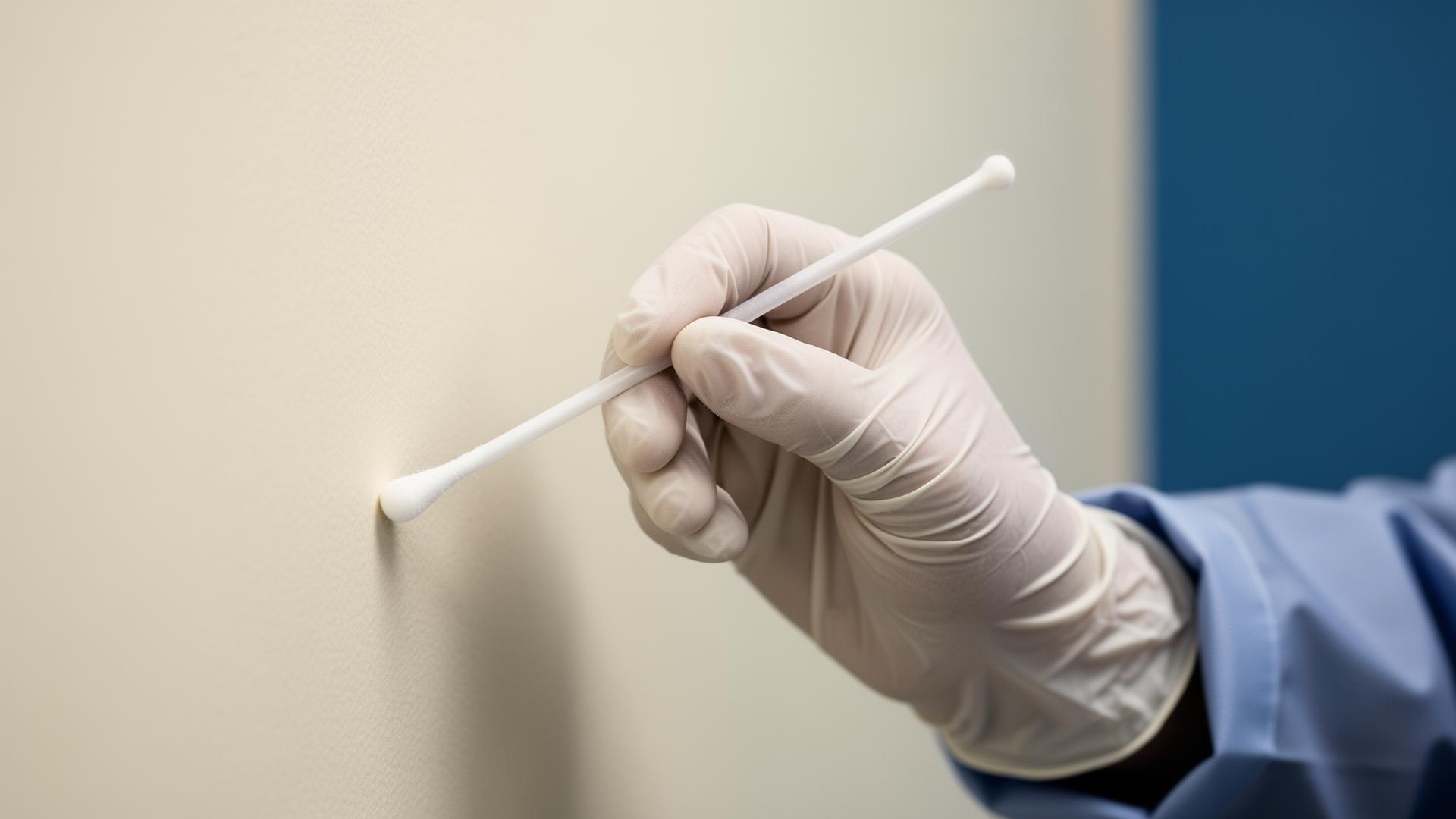
The most common misconception about methamphetamine contamination — and the most expensive misconception a property owner can hold — is that the contamination can be removed by thorough cleaning. It cannot. Standard cleaning chemicals do not break methamphetamine residue down. They spread it. Understanding why requires a brief detour into the chemistry of the substance and the surfaces it bonds to.
What methamphetamine residue actually is
Methamphetamine, in the form found on surfaces after smoking or manufacturing, is a stable organic compound with a molecular weight of 149.24 grams per mole, a melting point of 170 degrees Celsius, and high solubility in water and most polar solvents. The residue that settles onto surfaces from smoke or manufacturing vapour is a fine, oily film that adheres to almost any surface it contacts. It bonds particularly tightly to porous and semi-porous materials — paint, plasterboard, timber, carpet, fabric, ceiling tile, and the internal lining of ductwork.
Critically, methamphetamine is chemically stable. It does not degrade meaningfully through evaporation, sunlight exposure, or normal indoor temperature ranges. A property contaminated five years ago and unoccupied since will still test positive for methamphetamine residue today.
Why standard cleaning fails
Standard cleaning chemicals — including most commercial detergents, multi-surface cleaners, alcohol-based wipes, and even industrial degreasers — are designed to lift soiling from surfaces and suspend it in liquid for removal. They are not designed to break chemical bonds.
When methamphetamine residue is wiped with a standard cleaning chemical, three things happen. First, a portion of the residue dissolves into the cleaning solution. Second, that dissolved residue is carried by the cleaning cloth across other surfaces, depositing methamphetamine onto previously uncontaminated areas. Third, the residue that does not dissolve fully is pushed deeper into the porous surface — into the paint film, into the timber grain, into the carpet underlay — where it becomes harder to detect and impossible to remove without addressing the underlying material.
The practical consequence is that a property "cleaned" by ordinary methods after contamination is typically more uniformly contaminated than it was before cleaning, with the contamination distributed across surfaces that may not have been contaminated originally. Subsequent testing will detect residue on cleaned surfaces, often at levels that exceed pre-cleaning concentrations on those specific surfaces.
What proper decontamination involves
Proper methamphetamine decontamination is a chemistry process, not a cleaning process. It uses oxidative chemistry — specifically, hydrogen peroxide-based formulations at controlled concentrations — to break the methamphetamine molecule down into smaller, non-detectable, non-bioactive compounds. The chemistry is applied to surfaces in a documented sequence, under controlled containment, with controlled dwell times, by trained operators in appropriate personal protective equipment.
The work is staged. Source removal — removing surfaces that cannot be effectively decontaminated, such as heavily contaminated carpet, soft furnishings, ceiling tile, and certain types of porous timber — precedes chemical treatment. Chemical treatment is applied to remaining surfaces. Air handling systems are addressed separately. Post-treatment verification testing confirms that residual concentrations are below the Australian threshold.
Properties decontaminated correctly produce post-clearance results below 0.5 µg/100cm² on every surface tested. Properties subjected to standard cleaning by bond cleaners, detailers, or general remediation contractors typically produce post-clearance results above the threshold on at least one surface, and frequently on most surfaces.
The legal and insurance position
Hiring a non-specialist to address methamphetamine contamination has consequences beyond the technical failure of the work. Insurance claims for contamination remediation typically require that the work was undertaken by a qualified specialist following an accepted methodology — the Australian Voluntary Code of Practice for Methamphetamine Remediation in most cases. Work performed by a generalist cleaner does not meet that standard, and insurance payouts for subsequent re-remediation are routinely refused on this basis.
VCAT disputes between landlords, tenants, and remediation contractors frequently turn on whether the work performed was compliant with the AVCoP. Work performed without documented procedures, without trained operators, without independent post-clearance verification, and without proper containment is functionally indefensible in those proceedings.
Why this matters for property owners
For a landlord, property manager, or vendor confronted with a contaminated property, the decision to engage a generalist cleaner versus a methamphetamine specialist is not primarily a cost decision. The generalist cleaner is rarely cheaper once the failure mode is accounted for. The work is typically performed at a similar day rate, but it requires re-doing once contamination is found in post-clearance testing — at which point the property has been spread-contaminated rather than treated, and the second-stage remediation is more expensive than the first would have been.
The decision is a competence decision. Methamphetamine remediation has specific chemistry, specific procedures, specific documentation requirements, and specific competency standards. A property owner engaging a generalist is engaging someone whose tools do not match the problem.
SafeTrace performs both inspection and decontamination work, and we are explicit about the conflict of interest that arrangement creates — our laboratory analysis is processed by an independent NATA-accredited partner laboratory we do not own, and we recommend independent post-clearance verification on larger engagements. We are not the only competent operator in Victoria, and we will refer engagements where another specialist is better placed to serve a particular client. We are not, however, prepared to recommend any non-specialist remediation pathway for confirmed methamphetamine contamination, because no non-specialist pathway resolves the underlying chemistry.
For further information about decontamination scope and pricing for a specific property or vehicle, contact SafeTrace on 0400 407 896.